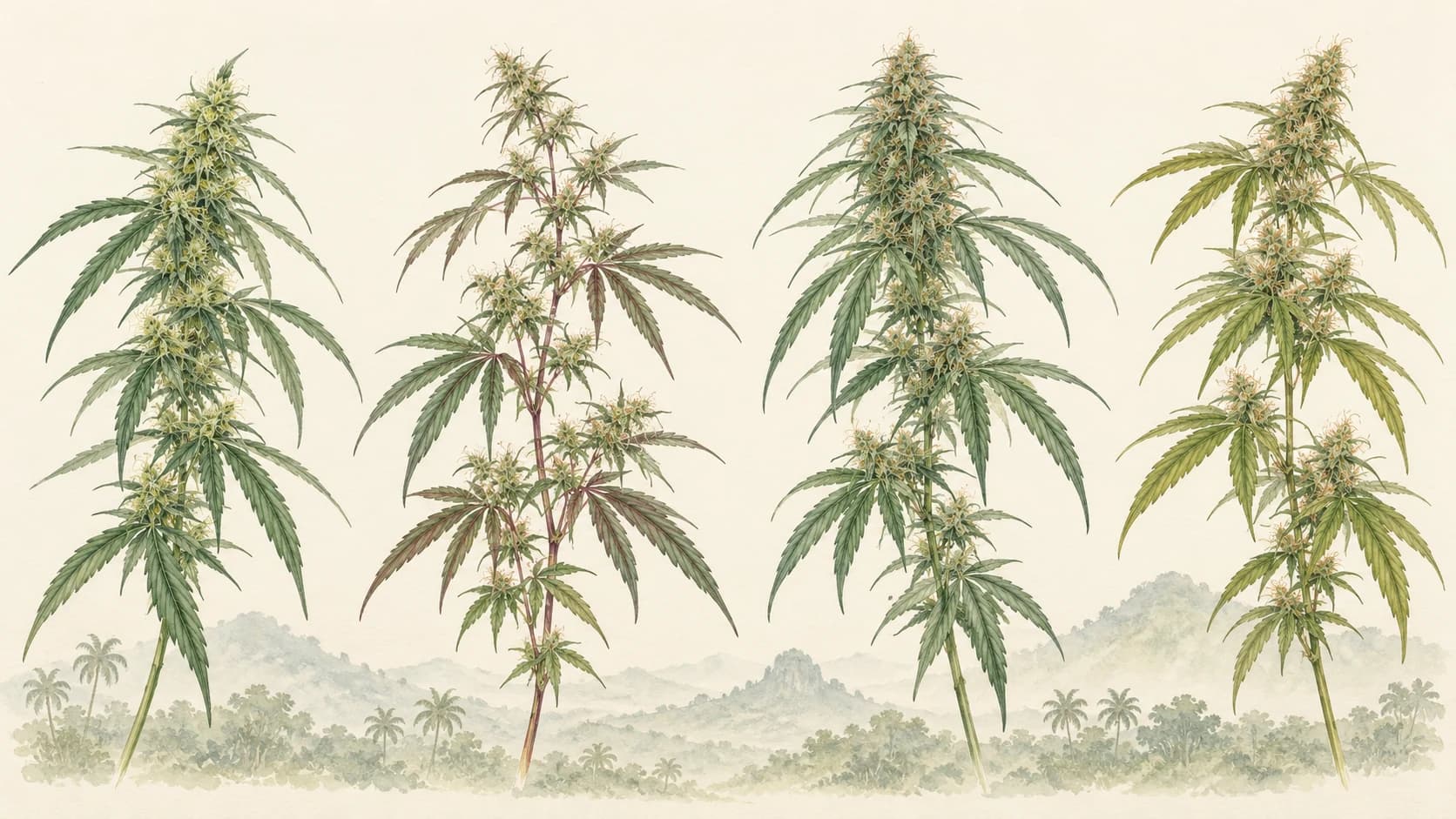
Four Thai cannabis varieties stand out in the country's medical cannabis research: ST1, TT1, WA1 and RD1. Each has its own appearance, aroma and balance of THC and CBD.
In June 2021, Thailand's Department of Medical Sciences described research into all four. The project examined their plant characteristics, chemical makeup and genetics to support future medical applications. Department of Medical Sciences
How the four strains compare
| Thai cannabis strain | Reported THC–CBD profile |
|---|---|
| Hang Kra Rog Phu Phan ST1 | Roughly equal amounts of THC and CBD |
| Hang Suea Sakon Nakhon TT1 | THC-dominant |
| Tanaosri Kan Khaw WA1 | THC-dominant |
| Tanaosri Kan Daeng RD1 | CBD-dominant |
These are the profiles described in the government's research announcement. They do not give an exact potency percentage for an individual product. Department of Medical Sciences
1. Hang Kra Rog Phu Phan ST1
ST1 has large, closely packed flower clusters shaped like a squirrel's tail. Its aroma is described as ripe mango, without a strong pungent smell.
Its defining chemical feature is an approximately 1:1 ratio of THC to CBD. Mahidol University
2. Hang Suea Sakon Nakhon TT1
TT1 has slender, elongated flower clusters. Its scent resembles orange peel, with a slightly pungent edge.
Researchers classify it as THC-dominant. Mahidol University
3. Tanaosri Kan Khaw WA1
WA1 produces tightly grouped flowers at the ends of its branches. Its aroma combines orange peel and lemongrass, with less pungency than TT1.
Like TT1, it is classified as THC-dominant. Mahidol University
4. Tanaosri Kan Daeng RD1
RD1 is recognised by its reddish branches, stems and leaf stalks. It has a sweet, ripe-fruit aroma.
Its main distinction is its CBD-dominant profile, which sets it apart from the other three varieties. Mahidol University
What does “government-approved” mean here?
The phrase needs context. These varieties were part of a government research programme, and the Department of Agriculture confirmed in January 2022 that all four had received plant-variety registration certificates.
The records support describing them as registered Thai cannabis varieties studied for medical use. They do not, by themselves, establish approval of a finished medicine or prove that a strain treats a particular condition. Department of Agriculture
Why these varieties matter
Studying local varieties gives researchers a clearer picture of Thailand's cannabis resources. The research programme also aimed to develop reliable seed sources through university partnerships and support Thai farmers.
Their value lies in that diversity: four named varieties with different characteristics for researchers to understand and compare. Department of Medical Sciences
Header image: AI-generated botanical illustration inspired by Thai cannabis. It is not a specimen identification guide.