CBD is often discussed for sleep, anxiety, pain and skincare. But which benefits have evidence behind them, and which are still being investigated?
Cannabidiol, or CBD, is a compound found in cannabis. It does not produce the characteristic THC high. That makes it interesting to people exploring cannabis-derived options, but it does not make every CBD product effective or harmless.
Here are ten reasons CBD attracts attention, with the evidence explained alongside each one. This is not a list of ten proven treatments: it includes an established prescription use, early research findings and a practical difference from THC.
For the basics, read our guide to CBD, side effects and product labels.
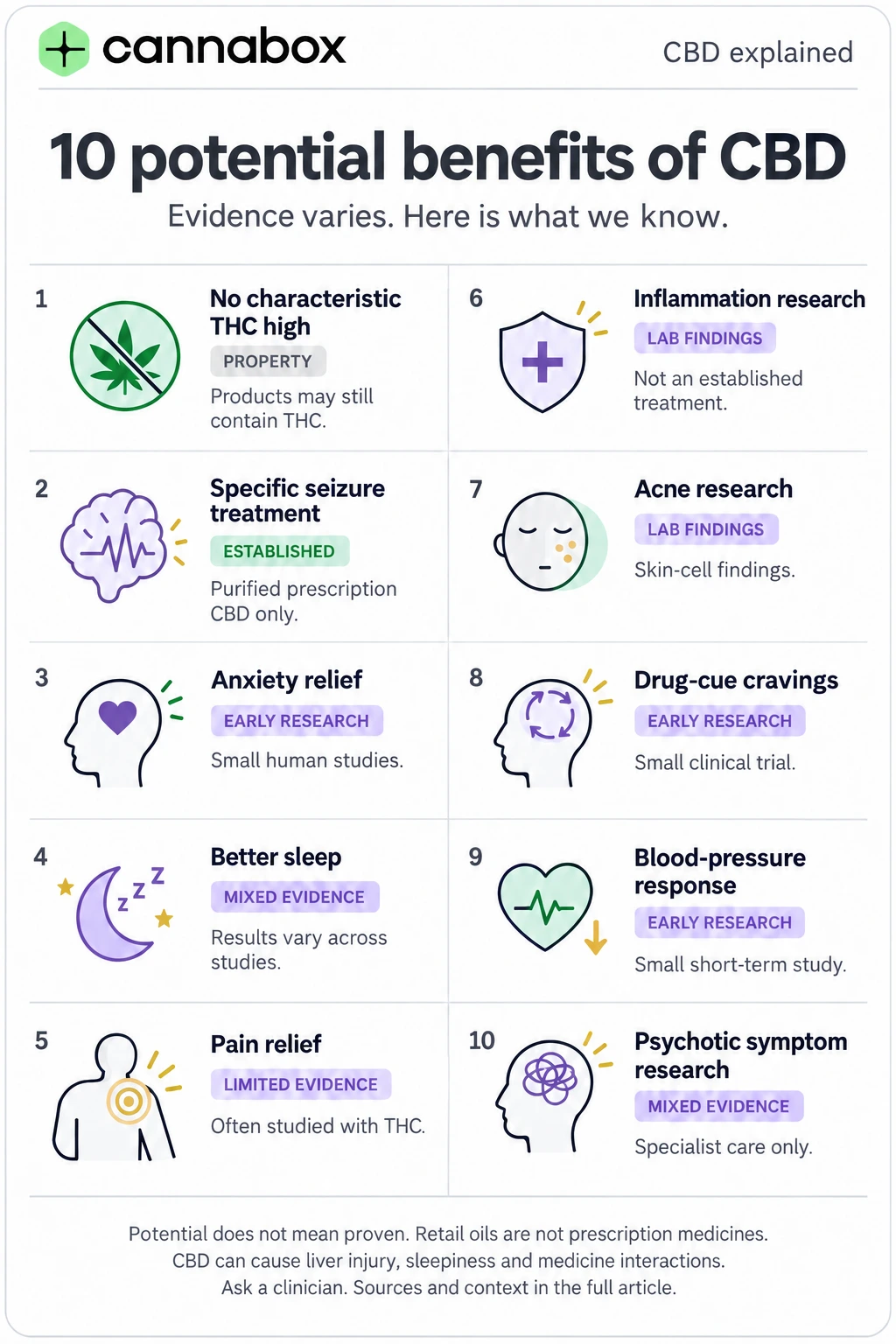
Evidence varies by condition and preparation. See the sources and limitations below for each point.
1. It does not produce the characteristic THC high
CBD itself does not cause the intoxicating high associated with THC. For people discussing cannabinoid treatment with a clinician, that difference can matter.
However, a CBD-labelled product may also contain THC. CBD can cause sleepiness, and being non-intoxicating does not mean a product is safe before driving. Check the actual ingredients and batch report. NCCIH overview.
2. Prescription CBD can reduce seizures in specific conditions
This is the clearest established medical benefit on this list. In the United States, the purified CBD medicine Epidiolex is approved for seizures associated with Lennox–Gastaut syndrome, Dravet syndrome and tuberous sclerosis complex in patients aged one year and older.
That approval applies to a defined prescription medicine under medical supervision. It does not mean retail CBD oils treat every form of epilepsy, or that the same medicine is approved or available in Thailand. FDA information on approved medicines.
3. It may reduce anxiety in some situations
Small human studies suggest CBD may reduce anxiety in particular settings. One study involving 24 people with social anxiety disorder found less anxiety during a simulated public-speaking task after CBD than after placebo.
That is an encouraging signal, but a small experiment cannot establish that a shop-bought oil treats an anxiety disorder. If anxiety affects daily life, discuss treatment options and medicine interactions with a qualified clinician. NCCIH anxiety evidence.
4. It is being studied for better sleep
Sleep is a common reason people ask about CBD, but results are mixed. A 2024 pilot trial involving 30 people with insomnia found that CBD was similar to placebo for most sleep outcomes, although some measures improved.
CBD is therefore a research topic rather than a reliably established insomnia treatment. Feeling sleepy is also different from improving sleep quality. Our cannabis and sleep guide explains the wider evidence. Randomized insomnia trial.
5. It is being investigated for pain relief
Pain is another common reason people explore CBD. Some research on cannabis-based medicines suggests a small benefit for certain chronic pain conditions, but many studies involve THC-containing preparations rather than CBD alone.
Results from a THC-and-CBD medicine cannot establish that an ordinary CBD oil will relieve back pain, joint pain or nerve pain. The useful question is whether the evidence matches your condition and the exact preparation being considered. NCCIH pain evidence.
6. It may influence inflammatory processes
Laboratory research has found anti-inflammatory effects of CBD in particular cell models. These findings help researchers identify possible future uses.
They do not prove that taking CBD oil reduces inflammation throughout the body or treats an inflammatory disease. A mechanism observed in a laboratory is a starting point for clinical research, not a treatment promise. Laboratory research on CBD and inflammation.
7. It has potential applications in acne research
Researchers studying human skin cells and skin tissue found that CBD influenced excess oil production and inflammatory responses relevant to acne.
This makes CBD interesting for skincare research, but those laboratory findings do not demonstrate that every CBD cream clears acne. A cosmetic, oral oil and prescription medicine are different products; evidence for one cannot be transferred to another. Primary skin-cell study.
8. It may reduce certain addiction-related cravings
In a small randomized trial, CBD reduced drug-cue-related craving and anxiety in people with heroin use disorder who were abstinent from drugs.
That result supports further research. It does not establish CBD as a cure for addiction, a detox treatment or a replacement for established care. Anyone seeking help with substance use should discuss options with an addiction professional. Randomized craving study.
9. It may affect the blood-pressure response to stress
A small crossover study in nine healthy men found that a single dose of CBD lowered resting systolic blood pressure and reduced some blood-pressure responses to stress. Heart rate also increased.
These short-term findings do not demonstrate prevention of heart disease or an established treatment for hypertension. A change in blood pressure can also be unwanted, especially alongside other medicines. Do not replace prescribed blood-pressure treatment with CBD. Primary cardiovascular study.
10. It is being studied as an additional treatment for psychotic symptoms
An exploratory randomized trial studied CBD alongside existing antipsychotic medication in people with schizophrenia and reported improvement in some symptoms compared with placebo.
This is specialist research, not a reason to self-treat with retail CBD or stop psychiatric medication. Other research has not shown the same benefits consistently. A history of psychosis calls for specialist advice, particularly because CBD-labelled products can contain THC. Adjunctive CBD trial, separate placebo-controlled trial.
What to know before considering CBD
CBD can cause side effects and interact with medicines. The FDA identifies risks including liver injury, sleepiness and gastrointestinal problems. Some liver problems may require blood tests to detect. FDA consumer guidance.
Before considering a product:
- Tell your clinician about prescription medicines, supplements, alcohol and sedatives.
- Seek medical advice if you have liver disease or a mental-health history.
- Avoid CBD during pregnancy or breastfeeding.
- Do not drive if sleepy or impaired.
- Check CBD units, THC content, ingredients and a batch-matched laboratory report.
- Check the actual product's status in Thailand; a foreign approval does not establish local approval.
Full-spectrum, broad-spectrum and isolate describe composition rather than a ranking of treatment effectiveness. Read our CBD spectrum-label guide for help understanding the differences.
Frequently asked questions
What is the best-proven benefit of CBD?
The clearest established use discussed here is purified prescription CBD for seizures associated with specific conditions. That evidence does not apply automatically to ordinary oils or gummies.
Does CBD help everyone sleep better?
No. Sleep studies have produced mixed results, and CBD is not a guaranteed sleep aid. Persistent insomnia deserves assessment rather than repeated product changes.
Can CBD cure cancer?
CBD is not an established cancer cure. Findings in cells or animals do not demonstrate that it treats cancer in people. Discuss symptoms and treatment side effects with your oncology team.
How much CBD should I take?
This article does not recommend a dose. Research preparations, retail formulations and individual medical circumstances differ. Ask a qualified professional about the actual product rather than copying a study dose.
Start with your treatment question
The most useful starting point is the symptom you want help with, the care you already receive and the evidence for the exact preparation. Bring that information and a product label to a qualified clinician.
If you are seeking medical cannabis care in Thailand, our prescription guide explains the assessment process.