Thai stick is a traditional tied preparation linked to Thai cannabis heritage. Its exact invention date is unknown.
Is Thai stick a strain?
Historically it describes a tied preparation. The same name also appears in strain directories and modern products.
Is it the oldest strain?
The evidence does not establish an oldest-strain ranking or invention date. International recognition is documented in the Vietnam War era.
Did Thai stick contain opium?
Historian Peter Maguire rejects opium as a defining ingredient of the classic preparation. That account does not chemically verify every historical product.
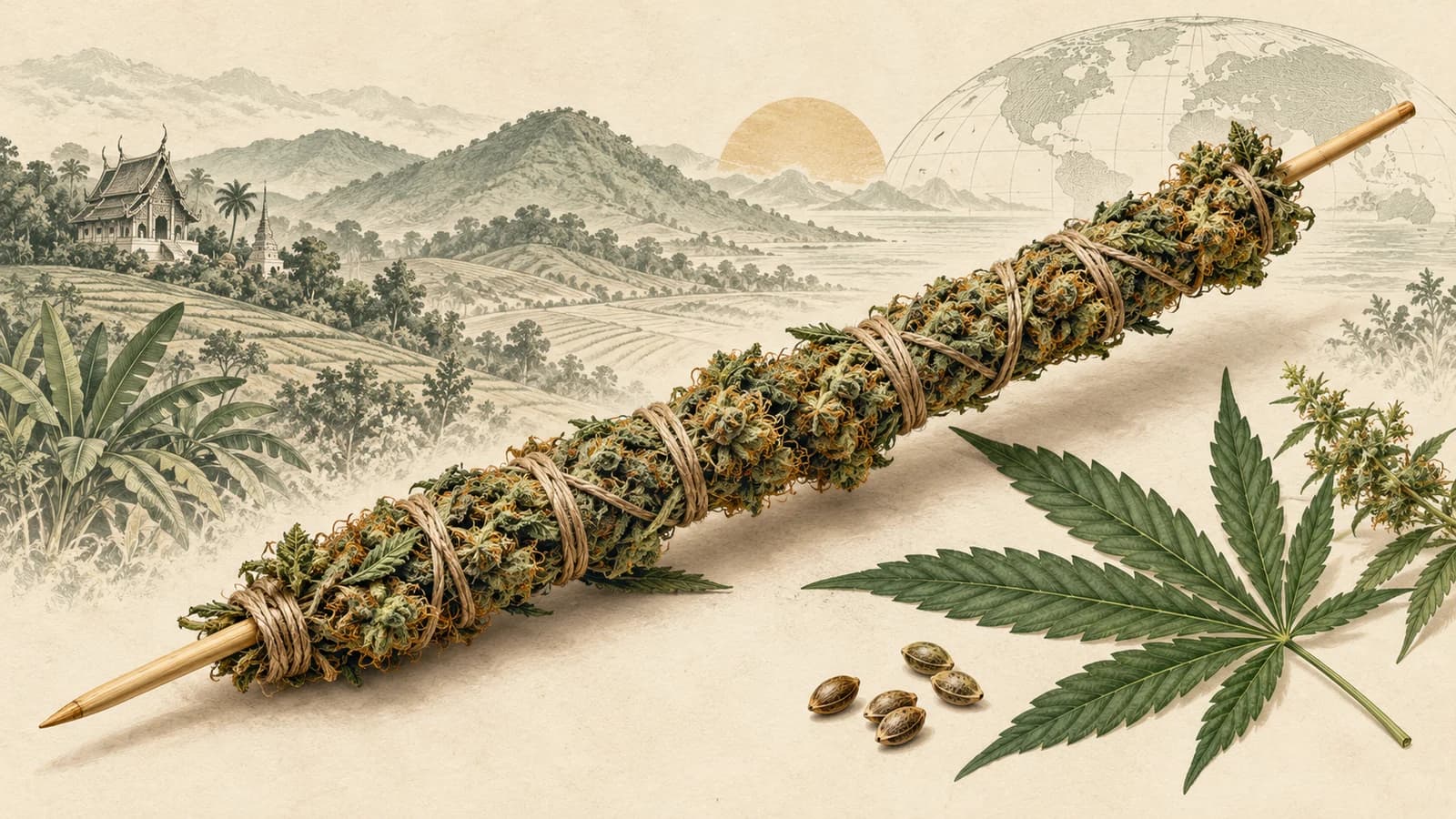
Thai stick is a traditional cannabis preparation associated with Thailand: flower tied around a slender stick, often bamboo, with thread or plant fibre. It became internationally famous during the 1960s and 1970s. Its heritage belongs to both the cannabis grown by Thai farmers and the skill used to prepare it. Historian Peter Maguire describes the tied bundle in his .
The name also appears on strain menus and modern cannabis cigars. Those uses overlap, but they do not establish that every product called Thai Stick contains the same genetics or follows the historical preparation. Our guide to sativa and indica labels explains why a familiar cannabis name cannot substitute for a chemical profile.
To understand its importance, follow three connected stories: Thailand’s local cannabis varieties, an international trade that carried their reputation abroad, and the later breeding and craft traditions that drew on Thai cannabis.
What is Thai stick: a strain or a preparation?
The most useful historical definition describes a form of prepared cannabis. Flower was bound around a small stick, creating a compact, recognisable bundle. In Maguire’s account, people could subsequently wrap the flower in paper and remove the supporting stick. That differs from the fully leaf-wrapped, sometimes concentrate-infused cigars now sold under the same name. .
“Thai” also names cannabis associated with Thailand. Leafly’s strain directory lists Thai with the aliases Thai Stick and Thailand, explaining that the stick name comes from the way its flowers were traditionally prepared. This helps explain why a search can return both a historical product and a strain profile. .
| Term | What it describes | What the name alone cannot prove |
|---|---|---|
| Thai landrace | A traditional cannabis population associated with a locality and its cultivation history | One identical plant, a fixed THC percentage or an exact age |
| Historical Thai stick | Cannabis flower tied around a slender supporting stick | A single cultivar or a universal recipe |
| Modern Thai Stick product | A contemporary strain name or a product inspired by the traditional form | Unbroken ancestry from a particular historical Thai population |
| Cannagar | A cannabis cigar; modern examples may use different flowers, wrappers and added concentrates | Thai origin or Thai landrace genetics |

 Thai cannabis heritage
Cannabis flower, a supporting stick, and thread or plant fibre.
Traditional local cannabis populations and cultivation history, rather than a packaging method.
Flower tied around a slender stick. The form does not identify one cultivar or a founding date.
A contemporary cannabis cigar. Ingredients vary; Thai ancestry needs separate evidence.
Illustrative reconstruction, not an archival photograph. A leaf wrapper or added concentrate does not establish historical authenticity.
Why Thai stick belongs to Thailand’s cannabis heritage
Thai stick’s reputation did not begin with a modern seed catalogue. It grew around locally produced cannabis and a distinctive way of presenting it. Columbia University Press’s history of the trade identifies farms in northeastern Thailand as the starting point for shipments reaching American consumers. .
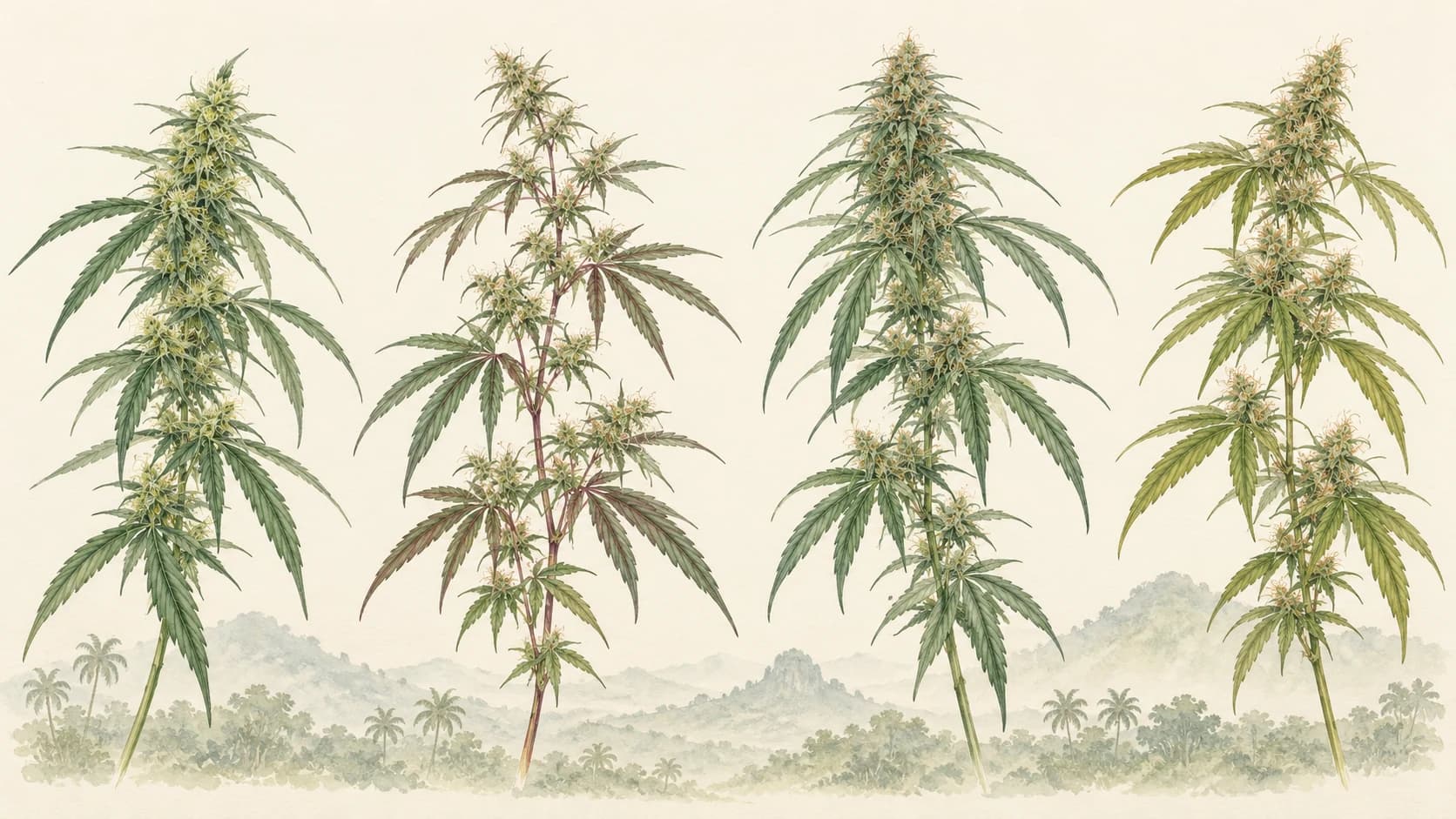
Calling the underlying cannabis a landrace needs care. Researchers use the term for a domesticated, locally adapted traditional variety. It does not mean that humans never selected the plants, or that every plant in a region is genetically identical. The distinction matters because farmers’ seed choices and growing practices are part of the heritage too. .
The enduring value is therefore broader than an old product name. It includes local plant diversity, knowledge passed between growers, and the identity of the communities that maintained it. A history focused only on Western consumers and smugglers leaves those contributions in the background. For a present-day view of how growers connect with the wider industry, see our account of Thai cannabis supply chains.
Is Thai stick one of the oldest cannabis strains?
Thai stick is an established heritage name, and Thai landraces belong to older cultivation traditions that predate today’s commercial hybrids. But the evidence reviewed here does not establish a founding date for one uniform “Thai Stick” strain, or rank it as the world’s oldest.
Even Leafly’s glossary, which calls the product ancient, says its invention date is unknown. A responsible description is a traditional Thai preparation with a documented international history reaching back to the Vietnam War era. That wording recognises the heritage without inventing a birthday for it. .
Thai stick timeline: from local preparation to international legacy
Thai cannabis heritageOpen a date to read the event and its evidence.
Origins undatedLocal tradition
The first invention date of the tied preparation is not established.
1960s–1970sInternational recognition
Soldiers and travellers introduce Thai sticks to American audiences during the Vietnam War era.
Early 1970sNew Zealand: Buddha sticks
Historical research records Thai cannabis wrapped around thin bamboo sticks in New Zealand’s illicit market.
1978A dated Pacific trade record
A US court opinion records Thai sticks found aboard the Euphoric in Victoria, Canada, on 16 November 1978.
1980sAn export industry changes
Maguire describes larger shipments and major enforcement action; this is not an extinction date for Thai cannabis.
1998Thai ancestry in Dutch breeding
Dutch Passion dates its Dutch introduction of DJ Short’s Blueberry to 1998 and describes Thai ancestry.
2013The trade becomes written history
Columbia University Press publishes Thai Stick by Peter Maguire and Mike Ritter.
2021Thai variety research continues
Thailand studies four named varieties. This does not authenticate plants exported decades earlier.
These events do not prove one unbroken genetic line. The invention date remains unknown.
| Period | What the evidence tells us |
|---|---|
| Before international recognition | Local cultivation and preparation form the background; the exact invention date of the tied stick remains unknown. . |
| 1960s–1970s | Soldiers and travellers introduce Thai sticks to American audiences during the Vietnam War era. . |
| Early 1970s | Thai cannabis, known as Buddha sticks, reaches New Zealand’s illicit market. . |
| 1978 | A later US court opinion records Canadian police finding twelve Thai sticks aboard the Euphoric, alongside evidence concerning a Thailand-to-California shipment. . |
| 1980s | Maguire describes a trade changing in scale and facing major enforcement action. This is the changing export industry, not a proven extinction date for Thai cannabis. . |
| 1998 | Dutch Passion says it introduces DJ Short’s Blueberry to the Dutch market; its documented breeder description includes Thai ancestry. . |
| 2013 | Columbia University Press publishes Maguire and Ritter’s Thai Stick, preserving accounts of the international trade. . |
| 2021 | Thailand’s Department of Medical Sciences reports research into four named Thai varieties, illustrating continuing scientific interest in local cannabis diversity. . |
How Thai cannabis influenced other countries
Its influence travelled through more than one channel. Imported flower carried the Thai stick name into overseas markets. Cannabis genetics entered breeding programmes. Later craftspeople adapted the stick-based form into contemporary cigars. These are related developments, but evidence for one does not automatically prove another.
Thai cannabis heritageChoose a country to see the documented connection.
Trade histories follow northeastern Thai farms to American consumers. A court opinion also records a 1978 shipment associated with California.
A trade connection does not establish the ancestry of a modern cultivar.
The Tahuna opinion records Canadian police finding twelve Thai sticks aboard the Euphoric in Victoria on 16 November 1978.
One documented encounter does not measure prevalence across Canada.
Australian crime histories describe Thai cannabis imports in the late 1970s, placing Thailand within a wider Pacific trade.
Thai cannabis imports are not proof that every shipment consisted of tied sticks.
A University of Canterbury thesis describes early-1970s Buddha sticks: Thai cannabis wrapped around thin bamboo.
This supports a historical connection to the preparation, not an estimate of its market size.
Dutch Passion describes Thai, Afghani and Oaxacan ancestry in Blueberry, introduced to its Dutch market in 1998.
This is a breeder’s account. Haze’s early pedigree remains disputed.
·Modern cannabis cigars can borrow the form even when their flower has no Thai ancestry.
Examples of influence, not a shipping-route map. Trade records do not prove genetic ancestry.
United States: a recognised imported cannabis name
Maguire and Ritter’s research follows the movement from northeastern Thai farms to American consumers, with surfers, travellers and former servicemen among its participants. Their book’s publisher describes an industry reconstructed through hundreds of interviews with traders and law enforcement. .
The record is more than nostalgia. The Tahuna court opinion discusses a 1978 shipment from Thailand associated with a transfer offshore from San Francisco. It provides a dated legal record of the trade rather than relying solely on later recollections. .
Canada: a documented encounter, with limits
The same opinion records the Royal Canadian Mounted Police’s discovery of Thai sticks aboard the Euphoric in Victoria, British Columbia, on 16 November 1978. That establishes a Canadian encounter with the product in a particular case. It does not, by itself, measure how common Thai sticks were across Canada. .
Australia and New Zealand: a wider Pacific story
Australian crime histories document Thai cannabis shipments in the late 1970s. This places Thailand within a broader Pacific trade, although a record of Thai cannabis should not be treated as proof that every shipment consisted of tied sticks. .
New Zealand provides a more specific connection to the form. A University of Canterbury thesis describes Thai “Buddha sticks” arriving in the early 1970s and identifies them as cannabis wrapped around thin bamboo sticks. The local name became part of the imported product’s identity. .
Netherlands: Thai ancestry in modern breeding
Dutch Passion describes Blueberry’s genetic foundation as Afghani, Thai and Oaxacan ancestry, and dates its Dutch introduction to 1998. This is a concrete example of Thai cannabis contributing to an internationally known cultivar. It is the breeder’s account of its lineage, rather than independent DNA verification of every product sold as Blueberry. .
Haze is also frequently linked to Thai cannabis, including in Leafly’s Thai profile. However, Sensi Seeds’ account presents competing explanations for Haze’s origins. The appropriate conclusion is that Thai and other Southeast Asian cannabis feature in Haze breeding histories; a tidy, universally agreed family tree would overstate the record. , .
Contemporary craft: the cannagar connection
Thai stick also left a recognisable design: cannabis organised around a supporting core. A 2017 High Times article written by cannabis cigar makers describes their adaptation of that form into modern craft products. It is useful first-person evidence for a revival, even though its broader historical and health claims need separate scrutiny. .
This influence can survive even when the flower changes. A cigar made with a modern hybrid may borrow the old structure without preserving Thai landrace ancestry. Aroma is no proof of origin either: our cannabis aroma and terpenes guide discusses what sensory descriptions can and cannot establish.
Was Thai stick dipped in opium?
Stories about “opiated Thai sticks” remain part of cannabis folklore. Asked directly about them, Maguire rejects the idea that added opium explains the classic product, describing strong cannabis tied to bamboo instead. .
That account supports rejecting opium as a defining ingredient. It does not chemically verify every historical bundle or every modern product. The useful distinction is between a documented preparation and claims about adulteration that require evidence of their own.
Similarly, modern recipes using hash oil or other concentrates cannot establish that all historical Thai sticks were made that way. The product’s name is not an ingredient list.
What does Thai stick mean in Thailand today?
The name may refer to heritage cannabis, a contemporary cultivar, a crafted cigar or a business. Ask which meaning is intended before assuming that a label identifies the historical product.
For an ancestry claim, useful evidence includes the seed source, locality, collection history and subsequent breeding. Our cannabis traceability guide explains the records that can connect a contemporary product to its source. For a finished product, the relevant information includes its ingredients and batch documentation. Neither a bamboo core nor a heritage name can establish potency, purity or suitability for medical treatment. See product quality beyond THC potency for a broader assessment of product evidence.
Thailand’s 2021 research into Hang Kra Rog Phu Phan ST1, Hang Suea Sakon Nakhon TT1, Tanaosri Kan Khaw WA1 and Tanaosri Kan Daeng RD1 also shows why “Thai cannabis” should not be reduced to one chemical profile. The Department of Medical Sciences described different THC–CBD patterns among these varieties. That study does not establish that they are the same plants exported decades earlier. . Read our guide to four Thai cannabis varieties. When considering a producer’s modern quality claims, our Thai medical cannabis producer guide explains how to check GACP documentation.
Heritage does not create a legal exemption. Thailand’s Tourism Authority says visitors need a valid Thai-issued prescription for cannabis flower under its 2025 guidance. A traditional presentation does not remove those requirements. Check our Thailand cannabis laws guide and the before making current access decisions. Our medical cannabis prescription guide covers the current consultation and prescription process.
Thai stick deserves a place in cannabis history because it connects Thai agricultural knowledge with a name recognised far beyond Thailand. Preserving that legacy means documenting the people, plants and preparation behind it, with enough care to distinguish evidence from an appealing legend. Explore more background in Cannabox’s cannabis history library.
Frequently asked questions
Is Thai stick the same as Thai cannabis?
Thai cannabis identifies an origin or a named variety. Historically, Thai stick identifies a tied preparation. Strain directories sometimes use the names interchangeably, so context matters.
Is every Thai stick a cannabis cigar?
No single recipe covers all historical accounts. A tied flower bundle and a modern leaf-wrapped, concentrate-infused cannagar can share a basic form while differing in ingredients and preparation.
What is the oldest documented date for Thai stick?
The sources reviewed place its international recognition in the Vietnam War era and document its trade during the 1970s. They do not establish its first invention or justify a precise ancient date.
Does Thai stick have a fixed THC percentage?
No. The name covers different plant material and preparations. A percentage requires testing of the particular batch; historical reputation cannot supply it.
Did Thai stick create Blueberry or Haze?
Thai cannabis ancestry appears in breeding accounts for those cultivars. That is different from proving that a specific tied stick founded a modern line. Blueberry has a clear breeder account; Haze’s early history remains disputed.
Can a product sold today be authenticated by its name?
The name alone cannot authenticate ancestry. Ask for provenance and product documentation that match the claim being made.
Research note: This article synthesises historical records, scholarly research, breeder accounts and official Thai information. It includes no interviews conducted by Cannabox, original genetic testing or clinical review. The cover is an AI-generated editorial illustration; the diagrams are illustrative reconstructions. Sources were checked on 11 October 2026; historical recollections and commercial lineage accounts are identified where used.
Sources and further reading
Source 1. Columbia University Press: Peter Maguire interview (2013), preparation, trade and opium folklore
Source 2. Leafly: Thai strain directory entry and naming aliases
Source 4. Whole-genome research: traditional cannabis populations and the landrace definition
Source 5. Leafly glossary: Thai stick origins and Vietnam War era recognition
Source 6. University of Canterbury: The History of Drug Crime and Policy in New Zealand, printed p. 45
Source 8. Dutch Passion: Blueberry breeder history, Thai ancestry and 1998 Dutch introduction
Source 9. Thai Department of Medical Sciences: four-variety research announcement (21 June 2021)
Source 10. Sydney Crime Museum: historical Thai cannabis imports into Australia
Source 11. Sensi Seeds: competing accounts of Haze origins
Source 12. High Times: a first-person account of contemporary cannabis cigar craft (2017)
Source 13. Tourism Authority of Thailand: cannabis flower notice for tourists (2025)